Skywork open-sources Matrix-Game 4.0, a neural renderer for playable low-poly games
Matrix-Game 4.0 keeps gameplay and physics in a real game engine and uses a streaming video model to repaint its low-poly frames. Code, three playable games and model weights are released under Apache 2.0.
15 October 2026 · 3 min read
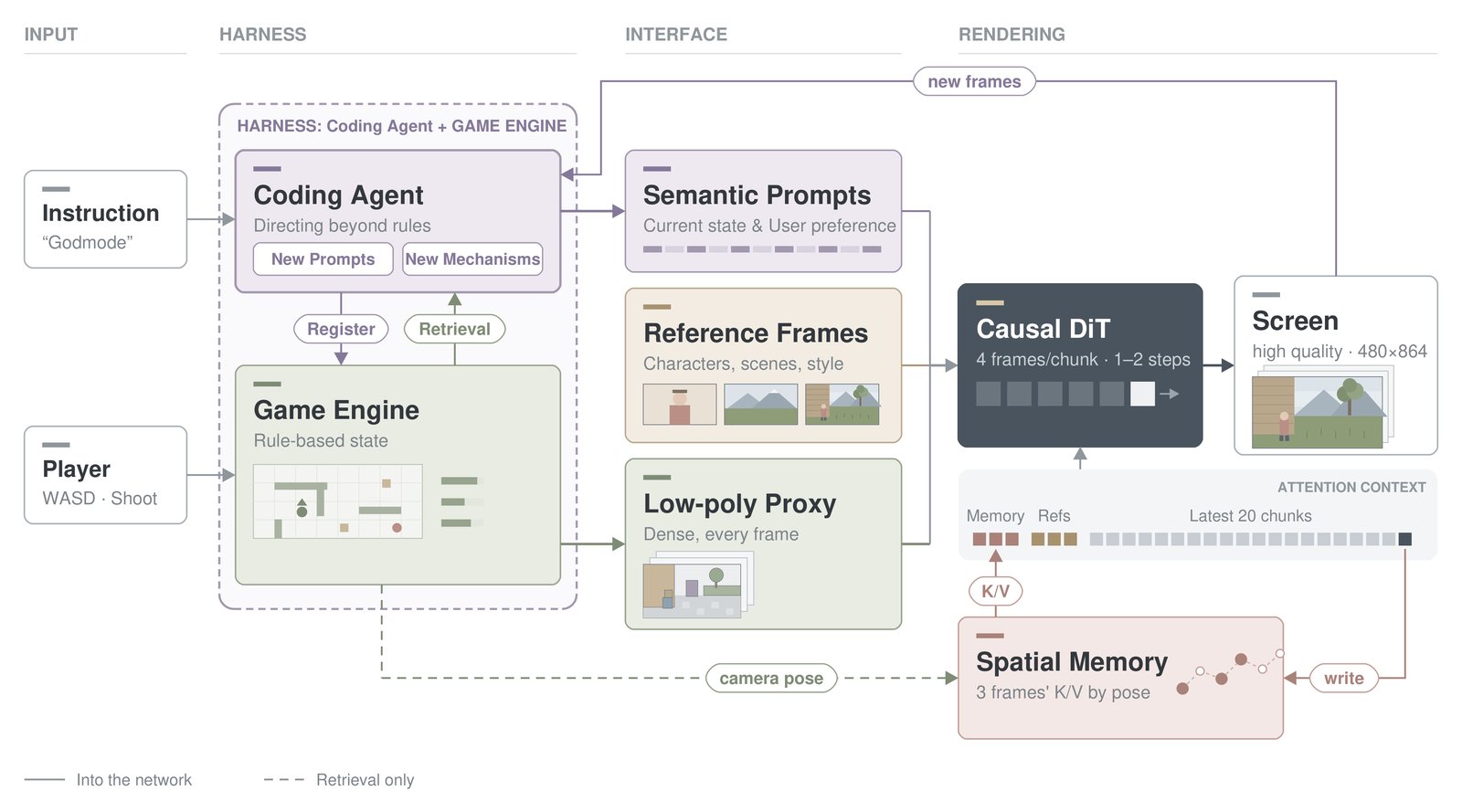
Skywork AI released Matrix-Game 4.0 on 15 October 2026, the fourth version of its open-source series of interactive world models. Unlike the earlier releases, which asked a video model to imagine the game world from player input alone, version 4.0 splits the job in two: an ordinary executable game engine handles gameplay, physics and controls, and a causal video model takes the engine’s plain low-poly RGB frames and renders them as detailed visuals in a continuous stream. The inference code, the source of three games and the model weights are all public.
What was released
The GitHub repository contains the inference stack, an offline renderer, a single-user browser demo that streams over WebRTC, and the source code of three native games. Model weights and game assets are hosted on Hugging Face, with one checkpoint per scene:
- Medieval Castle and Ancient Egypt, both third-person shooters.
- City Racing, a driving game with time trials and pursuit modes.
According to the project README, the shooter scenes use a fixed text prompt, while the racing game can also send dynamic, chunk-aligned scene descriptions from the engine as the view changes. HUD elements and sound are kept outside the model as separate, frame-aligned layers, so the interface stays legible regardless of what the renderer does.
The release builds on shared components that are downloaded from their own upstream sources, including a umT5 text encoder and the Wan VAE, alongside a faster TAEHV codec. The team published a technical report on 16 October.
On performance, the README reports roughly 38-39 frames per second of model processing for the shooter scenes on a single NVIDIA A100 80 GB at 864 x 480, using one denoising step. Optimised presets for consumer cards followed within two days: the project states up to 67 fps on an RTX 5080 and 58 fps on an RTX 5070 Ti at the same resolution, with fixed prompts and the optional SageAttention backend. The authors are explicit that these are steady-state model throughput figures that exclude video encoding, network transport and browser decoding, so they are not a measure of the latency a player would feel.
How AI game designers could use it
The interesting idea here is architectural rather than any single benchmark. Pure video world models struggle with persistent state: objects drift, rules bend and scores are hard to keep. Matrix-Game 4.0 sidesteps that by leaving the rules where they have always lived, in deterministic engine code, and using the generative model purely as a presentation layer. For designers, that suggests a workable pattern:
- Build and balance a game with greybox, low-poly geometry, then treat the visual style as something a model applies on top.
- Change terrain, object placement, NPC behaviour or game rules in the engine source and test them without loading any model weights. The README describes this as a deliberate workflow, including editing the games with a coding agent.
- Record low-poly play sessions and render them offline to explore how a scene reads in a different visual treatment before committing to art production.
Because gameplay never passes through the model, collision, scoring and win conditions stay reliable, which is the main obstacle to building anything rule-bound on top of earlier world models.
Licence and caveats
The Matrix-Game 4.0 code is released under the Apache 2.0 licence, and the Hugging Face model repository is also tagged Apache 2.0. The README notes that vendored third-party components keep their original licences and that model and asset distributions carry their own licence statements, so anyone planning commercial use should check the notices for each part, including the upstream base-model files.
There are practical limits. Model inference is Linux-only and needs an NVIDIA GPU; the RTX 5080 and 5070 Ti paths support fixed prompts only. Each server process handles one game session and one scene model, and the authors describe the browser demo as a trusted single-user setup that should not be exposed directly to the internet. The three checkpoints are trained for their specific scenes, so this is not yet a general renderer that can be pointed at any game.
The takeaway
Matrix-Game 4.0 is a useful open reference for a hybrid approach to generative games: keep the simulation in code and let a video model handle the look. It runs at interactive frame rates on high-end consumer GPUs, and its permissive licence makes it a practical base for experiments, provided its scene-specific checkpoints and single-session limits are taken into account.
Source: Project GitHub ↗