Gradium releases Phonon, a family of tiny open-weight text-to-speech models
Gradium has published 31m and 40m parameter Phonon TTS models that run on CPUs, phones and in the browser. The English 31m model is Apache 2.0; the 40m models are non-commercial.
20 October 2026 · 3 min read
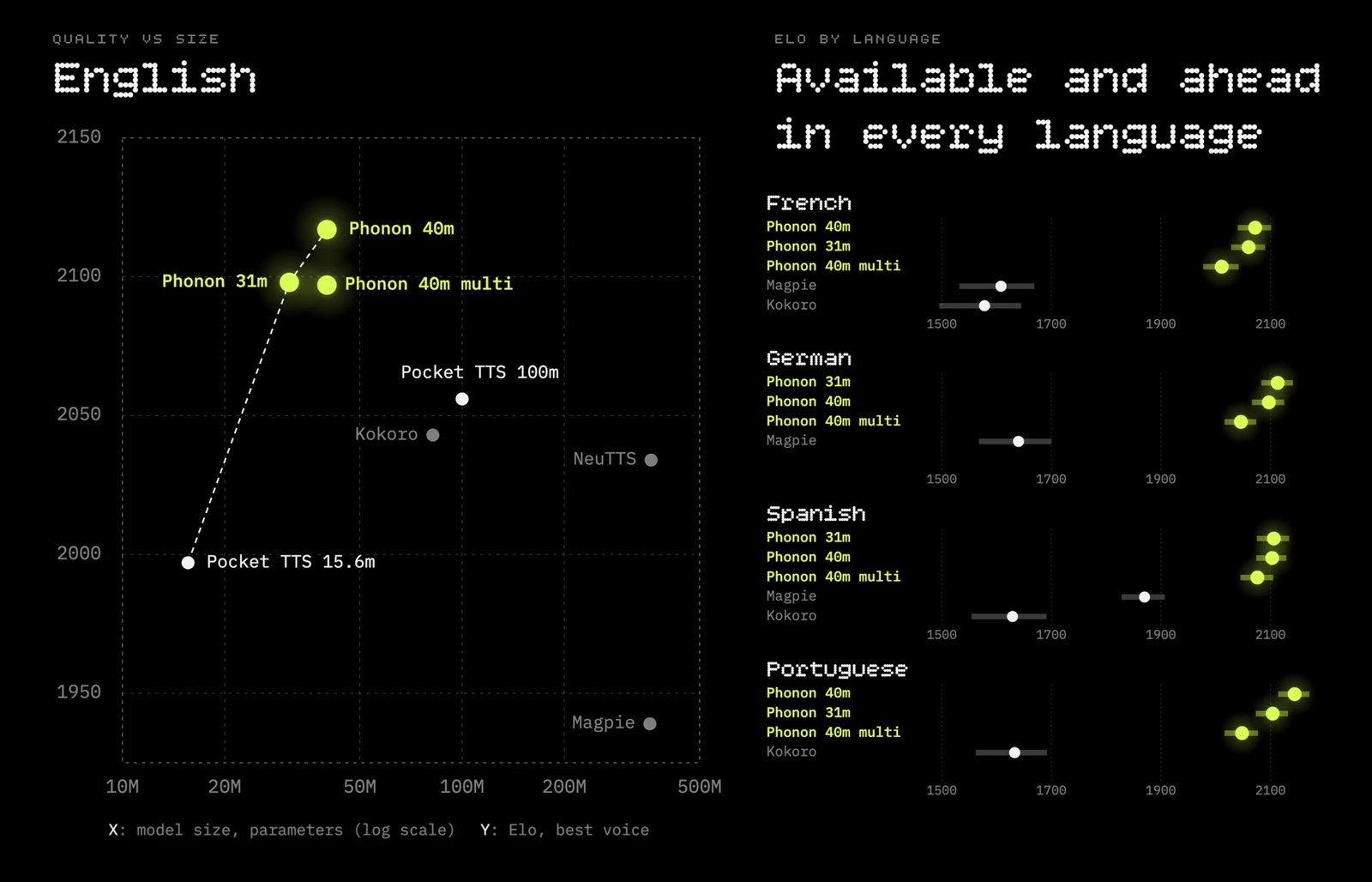
Gradium released the weights of Phonon, its family of small on-device text-to-speech models, on 20 October 2026. The release covers an English model with 31 million parameters and a set of 40 million parameter models in English, French, German, Spanish and Portuguese, plus one multilingual 40m model that handles all five languages. Gradium first announced Phonon in April and had kept it in private beta until now.
What was released
The models are on Hugging Face, with the inference runtime on GitHub as gradium-ai/xn-ptts. Each model ships as an 8-bit quantised GGUF file of around 65-75 MB. According to the model card, Phonon builds on Kyutai’s Pocket TTS and the Mimi audio codec: a flow-matching transformer predicts audio latents one 80 ms frame at a time, which the Mimi decoder turns into 24 kHz mono speech. Audio streams while it is still being generated.
Gradium also published a set of built-in voices, and the runtime has bindings for Rust, Python (with a command-line tool), Swift and JavaScript/WebAssembly, along with a WebSocket server and an OpenAI-compatible server. The company lists backends for CPU, Metal, CUDA, Vulkan, WebGPU and Apple Core ML.
Gradium’s own figures, which have not been independently verified here, put Phonon 31m’s time to first audio at about 7 ms on a MacBook Air M5 CPU using four threads, and say it runs 3.7 times faster than real time on a Raspberry Pi 5. The company also reports blind listening tests against Kokoro, Magpie, NeuTTS and Pocket TTS, and a word-error test on 500 hard sentences per language covering phone numbers, dates and codes. That test set is public on Hugging Face as gradium/tts-hard-sentences-202610, so the accuracy claim can be checked.
How AI game designers could use it
Voiced dialogue is one of the costliest parts of a generative game. If an LLM writes NPC lines at runtime, those lines either stay as text or have to be sent to a cloud speech service, with the latency, cost and connectivity requirements that brings. Gradium’s original April announcement named NPCs as a target use case, and a model this small changes the trade-offs:
- Local voiced NPCs. A 65 MB model that starts speaking in milliseconds on a CPU can sit beside a small local language model without needing a second GPU.
- Browser games. The WebAssembly and WebGPU paths mean speech can be generated inside the player’s browser tab, with no server or per-character cost.
- Structured text. Built-in text normalisation for numbers, dates and codes helps with game text such as scores, timers, item counts and quest coordinates, which general TTS models often misread.
- Prototyping. Designers can voice every line of a branching script during development and judge pacing by ear before casting actors.
Licence and caveats
The licences differ across the family, and this matters for anyone shipping a game. The English Phonon 31m model is released under Apache 2.0, which allows commercial use. All of the 40m models, including the multilingual one, are released under CC BY-NC 4.0, which rules out commercial use; Gradium invites commercial users to contact it. The inference runtime on GitHub, the voices repository and the bundled Mimi codec repository are Apache 2.0.
In practice, a commercial game can use the open release for English speech only, with the smaller model. Voice cloning and voice design are described as Gradium services rather than part of the open weights, so custom character voices beyond the built-in set are not covered by this release. The benchmark results come from Gradium itself.
The takeaway
Phonon is one of the smallest capable speech models now available with open weights, and its browser and CPU support make on-device NPC voices more realistic for small teams. The Apache 2.0 English 31m model is the one to evaluate for commercial projects; the multilingual 40m models are, for now, for research and non-commercial work.
Source: Gradium blog ↗