Runway shows GWM Worlds 2, a real-time world model driven by text actions
Runway's latest General World Model research preview generates interactive 720p video with audio at 24 fps, steered by text actions addressed to characters or the scene itself.
3 September 2026 · 3 min read

On 3 September 2026 Runway published research on GWM Worlds 2, the second version of its General World Model for interactive environments. The model generates a continuous stream of 720p video at 24 frames per second, with audio at 48,000 Hz, and keeps going in response to player input instead of playing back a fixed clip. Input comes as camera movement plus free-form text actions, which can be addressed to an individual character or to the scene as a whole. Runway calls it a research preview, and access is through an enquiry form rather than a public product.
What was announced
GWM Worlds 2 follows GWM Worlds, which Runway showed in December 2025. The new version is built on Runway’s foundational audio-video generation model. Runway says the main additions are generated audio and “rich subject and scene control”.
The core of the work is an input format Runway calls WorldPrompt. It divides a world into what persists and what changes over time:
- Persistent context: a “genesis prompt” describing the scene (layout, materials, lighting, ambient sound), the subjects who can take part in events, and the “laws” that govern behaviour, from gravity and collision to character abilities and camera perspective. A first frame anchors the visuals.
- A timestamped event stream: free-form text actions with start and end times, covering movement, gestures, object interactions, speech and sound. Actions can overlap. Alongside these sits a per-frame camera stream.
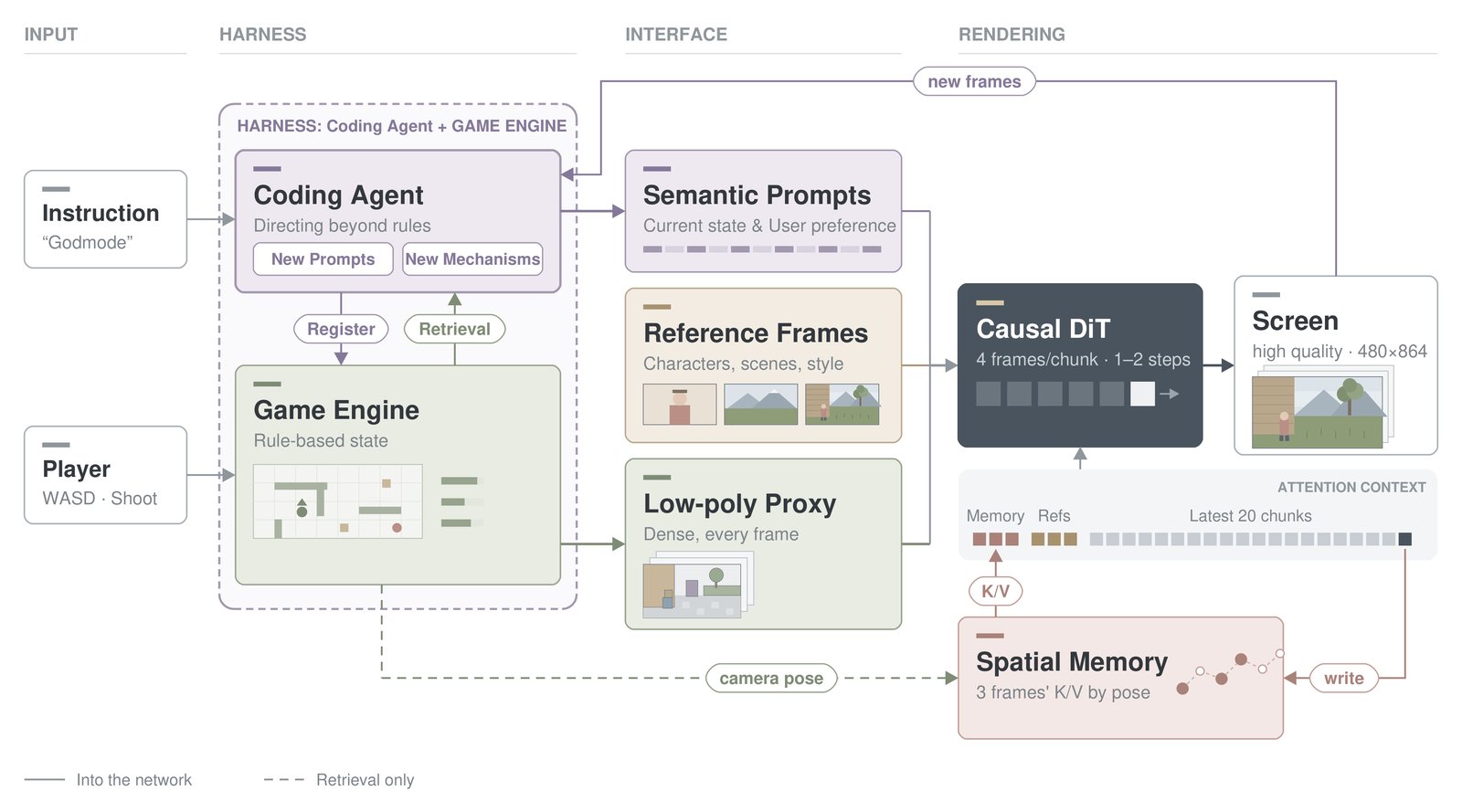
Runway first fine-tuned its audio-video model on this format, then post-trained it into a real-time autoregressive model. Each step conditions on the global context, the current frame’s camera and text inputs, and recent frames held in a sliding-window cache. Runway says that, unlike the bidirectional model it started from, GWM Worlds 2 “can generate indefinitely”.
The examples include first- and third-person navigation, characters speaking with generated lip movement, a “director” role changing the weather and lighting, multiplayer sessions in which different users control different subjects (broadcast via LiveKit), and AI agents steering characters towards simple goals. There is also an LLM-assisted authoring step that turns a short description into a first frame, a genesis prompt and a set of actions bound to keys.
Why it matters for AI game designers
The design idea that matters most here is the separation of persistent world rules from timestamped events. It is close to how designers already think about a game: a level, a cast and a rule set on one side, and a stream of player and system events on the other. Being able to address an action to the scene (“a dust storm rolling in”) as easily as to a character gives designers something like a director or game-master channel, not only a player controller.
Runway also sets out three ways to use the model: ahead of time (all actions written up front, suited to film), turn-based (generation pauses at decision points, suited to visual novels and interactive film) and real-time (suited to games). The turn-based mode is the most practical for small teams today. An LLM can turn a player’s choice into an event and the world model renders the result, and none of that needs millisecond reactions.
In the real-time demo, keys and mouse buttons are bound to prewritten prompts, so pressing W might send “The character moves forward”. That is a familiar input-mapping pattern, and it hints at how a control scheme could be designed for this kind of system.
Caveats
Runway is candid about the limits. It says “real-time generation still trades fidelity for speed”; quick camera rotations can degrade detail and geometry; long-term memory is “imperfect”; and image references are not supported beyond the first frame or a prefilled video. It also says the ahead-of-time mode currently looks better than live play, because prewritten prompts can describe more of the scene.
There is no game state in the usual sense. Runway notes that getting the most out of free-form control may need “an external real-time harness that tracks the state of the world”, such as a separate system handling NPC dialogue. Scores, inventories and win conditions would still have to live outside the model. No pricing, API or release date was given.
The takeaway
GWM Worlds 2 is a research preview, not a tool you can build a game on yet. Even so, WorldPrompt’s split between persistent rules and timestamped events is a useful template for designing anything that drives a generative world. The likely near-term uses are turn-based and director-style experiences, with conventional code keeping track of state.
Source: Runway Research ↗