Tencent open-sources Hy-Nomas, an 8B interactive world model
Tencent Hunyuan released Hy-Nomas, an Apache 2.0 video world model steered by text and camera moves across multiple turns, plus a 280-case benchmark.
· 3 min read · By Efe Anidi
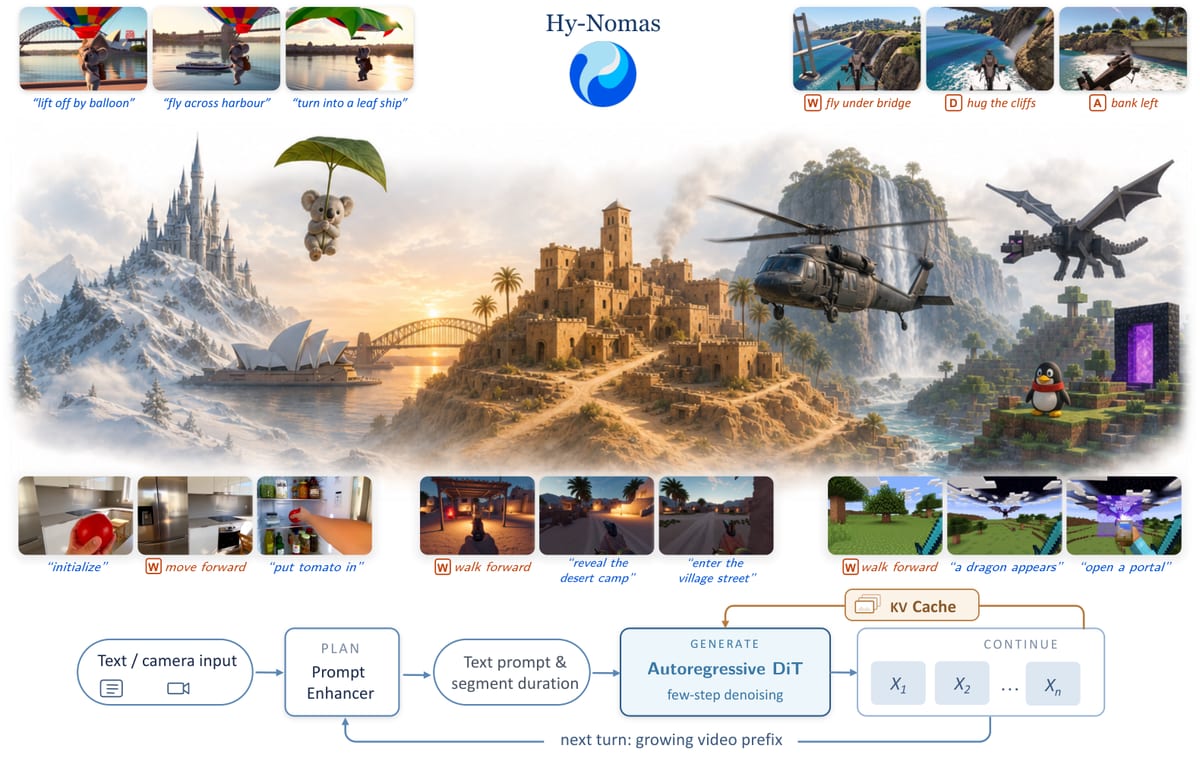
Tencent’s Hunyuan team released Hy-Nomas on 21 October 2026, an open-weight video world model that lets users redirect a running scene mid-session with text prompts and camera moves. The project’s technical report followed on arXiv on 27 October 2026, and on 29 October the team posted a video comparing Hy-Nomas against Google DeepMind’s Genie 4 by recreating Genie 4’s own demo prompts. Code, model weights and a benchmark suite are all public under the Apache 2.0 licence.
What Hy-Nomas does
Hy-Nomas is an 8B-parameter diffusion transformer built from 54 dual-stream blocks. Rather than generating one long video in a single pass, it works in segments: each one is conditioned on the user’s current text or camera instruction plus a cached history of everything generated so far, carried through a persistent key-value cache. Structured scene captions stay available across the whole session, while an action instruction only applies within its own segment, so a user can keep adding new directions, like a different camera angle, a style change, or a new object or character, without the system forgetting the scene that came before. A built-in vision-language “Prompt Enhancer” turns a user’s short request into the detailed structured prompt the video model needs for each segment.
The distilled version of the model needs as few as 4-8 denoising steps per segment, down from 100 before distillation, and outputs 1280x704 video at 24 frames per second. According to the technical report, a low-memory configuration using INT8 weights, an INT8 key-value cache and an FP8 decoder can generate a 100-second clip across seven segments on a single NVIDIA RTX 4090, peaking at 20.53 GiB of VRAM. Full-quality inference instead uses eight-way sequence parallelism, which needs eight GPUs.
The benchmark and the Genie comparisons
Alongside the model, Tencent published Hy-Nomas-Bench, a 280-case benchmark split across four test suites: multi-turn text instructions, camera navigation, interleaved text-and-camera control, and spatial memory. In the paper’s human evaluations on the multi-turn text suite, Hy-Nomas wins 65% of prompt-following comparisons against HappyOyster and 75% against LingBot-World v2. Genie 3 was only tested on camera navigation and spatial memory, because its API does not accept text-prompt interactions. On the spatial-memory suite, across 60 shared scenarios, the paper reports Hy-Nomas winning 13.3% of comparisons, tying 56.7% and losing 30.0%; the authors state plainly that Genie 3 remains stronger on long-term spatial consistency. These are Tencent’s own reported figures, run on its own benchmark, and have not been independently verified.
The 29 October video comparison against Genie 4, which Google DeepMind had announced just two days earlier, is a direct response rather than a benchmark: the Hunyuan team recreated several of Genie 4’s own published example prompts in Hy-Nomas to show how closely an open model can follow the same brief.
Why it matters for world builders
The appeal for anyone prototyping interactive stories or scenes is that Hy-Nomas is something you can actually download, inspect and fine-tune today, rather than a research preview behind a waitlist. The repository ships LoRA fine-tuning support and a data-preparation workflow for training on your own footage, plus community integrations already built for ComfyUI, the WanGP video app and the SGLang serving framework. That makes it realistic to adapt the base model to a specific visual style or recurring set of characters, and to test an interactive-narrative concept locally rather than through a hosted API.
Limits and what’s unclear
The paper describes its training data only in broad terms, as a large mix of real-world and virtual-environment video, and the material published so far includes no dataset list, total compute budget or safety evaluation. The report is credited to the Tencent Hy Visual Generation Team, and the technical report is labelled only as a “Technical Report” with no peer review. Running the model at its intended quality needs multiple high-end GPUs; the single-card path is explicitly a cut-down, quantised configuration. The comparison figures against Genie 3 and Genie 4 both come from Tencent itself, using prompts and a benchmark it designed, so independent testing of consistency, controllability and failure cases is still needed before builders should treat either comparison as settled.
Questions and answers
What is Hy-Nomas?
Hy-Nomas is an open-weight video world model from Tencent's Hunyuan team. It generates an explorable scene a segment at a time, and users can redirect it mid-session with free-form text instructions or camera moves rather than only steering it at the start.
Can I run Hy-Nomas myself, and what does it cost?
Yes. The code, model weights and benchmark are released under the Apache 2.0 licence on GitHub and Hugging Face, free to download. A low-memory inference path is built for a single NVIDIA RTX 4090; full-quality inference uses eight-way sequence parallelism across multiple GPUs.
How does it compare with Google DeepMind's Genie models?
Tencent compared Hy-Nomas with Genie 3 only on camera navigation and spatial memory, because Genie 3's API does not take text-prompt interactions. On spatial memory Hy-Nomas lost more comparisons than it won, and the authors say Genie 3 keeps scenes more consistent over time. These are Tencent's own figures and have not been independently verified.
Sources: