Tencent researchers unveil Wizard, an agentic world model for games
Wizard, from Tencent researchers, lets an agent edit a game world's explicit state and renders the result as real-time video at 24 FPS. Preprint out 29 October 2026.
· 3 min read · By Efe Anidi
On this page +
Tencent researchers Yuzhe Wu, Zijun Lin and Yeying Jin published a paper on 29 October 2026 introducing Wizard, an “agentic game world model” that generates real-time, controllable video of a game world by editing explicit state rather than just predicting pixels from a prompt. The work comes from Tencent, with Wu also affiliated with the National University of Singapore and Lin with Nanyang Technological University.
How Wizard works
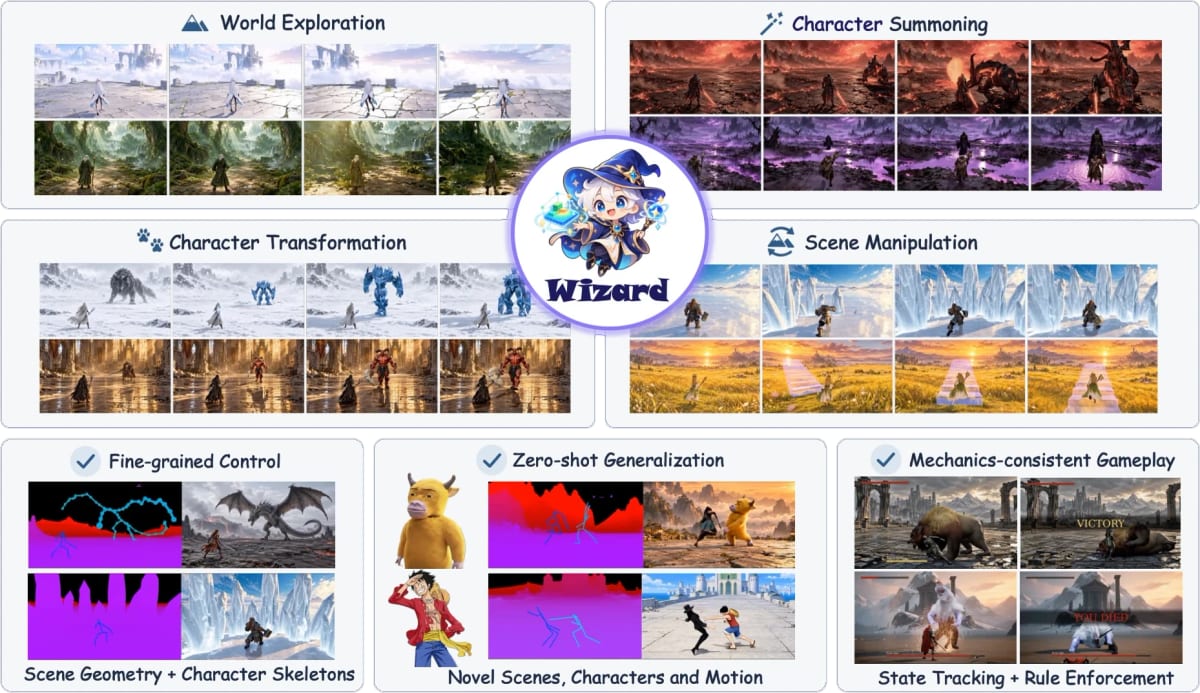
Instead of asking a video model to imagine what happens next, Wizard keeps a structured proxy of the world: scene geometry, an articulated skeleton for each character, and state such as health, action phases and cooldowns for combat. A play session can start from a single picture, and the player steers it with text commands or keyboard input; the agent updates the proxy and a video generator renders the result. That generator is built on Wan2.2-TI2V-5B, and the authors report it runs at 24 FPS with two denoising steps. Alongside the proxy, it sees the opening frame of the scene, a reference picture for each character and the frames it has already produced.
Before each session, a setup stage of under five minutes builds the proxy: Qwen3-VL infers each character’s body structure, SAM2, TripoSG and UniRig turn that into a labelled skeleton, and MoGe-2 recovers scene geometry and camera. A character-aware masking scheme restricts each reference picture to its own character’s region, so identities don’t bleed into one another. The authors claim the system generalises zero-shot to new scenes, characters and actions, and say every scene and character on the project page is new to the model.
What you can do with it, per the demos
The project page shows four modes: world exploration, character summoning, character transformation and scene manipulation. For scene edits, the player chooses a “spell” and the world agent turns it into a short program of geometric operations; the paper’s examples are lifting a platform out of the ground and flipping the world upside down. Interactive demos let visitors drag a divider across each clip to compare the rendered video with the proxy underneath it.
Combat runs on the same explicit state. A planner tries out candidate attacks, and a rule-based controller decides hits, damage, reactions and knock-outs, so health and cooldowns follow game rules rather than whatever the video model draws.
Training data
The model was trained on 50.3 hours of paired proxy-and-video footage across 750 scenes and 178 characters. The project page breaks that down as:
- WildWorld: 26.6 hours
- Synthetic clips: 11.6 hours
- Elden Ring recordings: 8.8 hours
- Unreal Engine boss-fight simulations: 3.3 hours
Why it matters for world builders
For people building interactive worlds and simulations, Wizard is a concrete example of keeping game logic (health, cooldowns, geometry) legible and editable by an agent, rather than folding everything into a video model’s latent space. A narrative designer could, in principle, script story beats as edits to that state — a boss appears, the ground rises — and leave the rendering to the model. Whether that holds up outside the authors’ demos can’t be tested until the code ships.
What’s still unknown
The preprint itself carries a CC BY 4.0 licence on arXiv, but no licence is given for code or model weights, and neither has been released; the project page simply says “Code soon”. The paper crops training frames to 832×480 but states neither the output resolution nor the GPU behind the 24 FPS figure. The work has not been peer-reviewed.
Questions and answers
What is Wizard?
Wizard is a research project from Tencent (with National University of Singapore and Nanyang Technological University co-authors) that treats a video game world as editable state — geometry, character skeletons and combat rules — and renders changes to that state as real-time video, rather than generating video directly from a prompt.
Can I use Wizard today?
No. The paper and project page are public, with demo clips of world exploration, character summoning, character transformation and scene manipulation, but code is marked "Code soon" and no model weights or code licence have been released.
What makes Wizard different from a prompt-to-video world model?
Wizard keeps the game's state explicit — scene geometry, character skeletons, health, action phases and cooldowns — and an agent edits that state directly. The video model only renders the result, so changes such as reshaping terrain (which the project page calls 'spells') are written as short programs of geometric operations rather than left to the video model to imagine.
Sources: