World Labs' Frameboy streams its Atlas world model in real time
World Labs has released Frameboy, a research preview that streams scenes from its Atlas world model to the browser at up to 15fps as you steer the camera.
· 3 min read · By Efe Anidi
On this page +
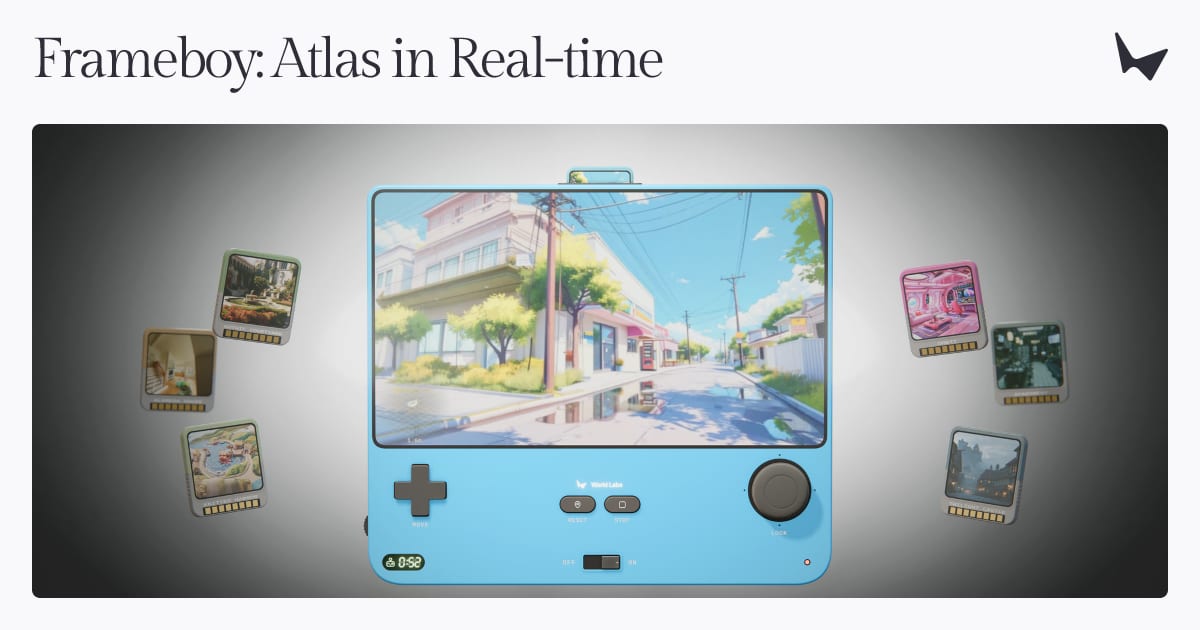
World Labs released a research preview called Frameboy on 5 November 2026. It is a browser demo at frameboy.worldlabs.ai that lets you steer a camera through scenes generated by the company’s Atlas world model, with new frames rendered on cloud GPUs and streamed back at up to 15 frames per second. The model behind it is a variant of Atlas tuned for the fastest, cheapest inference World Labs could manage without losing its ability to synthesise new viewpoints.
What Frameboy does
Atlas, which World Labs announced two months ago, is an autoregressive world model: it produces video one frame at a time and follows what the company calls pixel-perfect camera control. Until now, using it meant asking for a clip and waiting for it. Frameboy turns the same idea into a continuous stream, so the view updates as you move instead of after you press generate.
For now the preview covers a curated list of scenes, and the announcement explains how they were made:
- From one image. Atlas took a single starting picture and produced extra viewpoints to fill out the rest of the space. Frameboy holds those in its spatial context so the scene can be explored freely.
- From photos of real places. Multiview captures of well-known locations were used as input, which lets visitors walk around real-world scenes as well as invented ones.
World Labs has also wired the streaming into Viewfinder, its web app for building scenes frame by frame with Atlas. Each Viewfinder frame comes with colour and depth, and once a scene is built the user can switch on a Frameboy overlay to explore it live. Viewfinder is still in closed beta behind a waitlist.
Why speed matters to World Labs
The post argues that latency changes how people use a world model. If every result takes tens of seconds or minutes, users have to plan scenes and camera paths carefully, and they get through fewer rounds of iteration. When the response is close to instant, they can react and adjust as they go. In World Labs’ words: “When the cost of a ‘bad idea’ is near zero, there are no bad ideas.” Push latency and cost low enough, the company says, and generation stops feeling like a separate step at all.
Frameboy follows RTFM, a smaller frame-generation model World Labs released as a research preview last year. RTFM was mostly built to fill in views between an existing set of camera positions. Atlas is a much bigger model trained on far more data. It can build a scene from almost nothing, such as one image or a short text caption, and it can still work from a set of photos.
What builders could do with it
For people working on generative 3D, the gain is iteration speed rather than a new capability. World Labs suggests scouting virtual camera angles for a film shoot, roughing out a game level, checking progress on a construction site, or simulating an environment for a robot to move through. With live feedback at up to 15fps, a weak camera path or scene idea shows up straight away, so you can try more variations of a level layout or set before committing to a render.
Limits and open questions
World Labs says Frameboy has to run on a powerful cloud GPU server and is not cheap compared with local rendering. It has published no price, resolution, latency figure or model size, and the only performance number is the 15fps ceiling. The company expects costs to fall as hardware and software catch up, though it gives no timeline. The public preview is restricted to curated scenes, and building your own still requires a place in the Viewfinder beta.
Questions and answers
What is Frameboy?
Frameboy is a research preview from World Labs, at frameboy.worldlabs.ai, that lets users move a camera through scenes generated by the company's Atlas world model, with new frames streamed from cloud GPUs at up to 15 frames per second.
Can I use Frameboy today, and does it cost anything?
Frameboy is live as a research preview limited to a curated list of scenes. World Labs has not published any price; it says the service needs powerful cloud GPU servers and is expensive to run compared with local rendering.
How is Frameboy different from Atlas and Viewfinder?
Atlas is World Labs' autoregressive world model, which generates frames one at a time under camera control. Frameboy serves a speed-optimised variant of Atlas as a live, explorable demo. Viewfinder is a separate closed-beta web app for building scenes frame by frame with Atlas, which can now hand a finished scene to a Frameboy streaming session.
Source: